







 sales@doomshell.com
 +91 8005523567
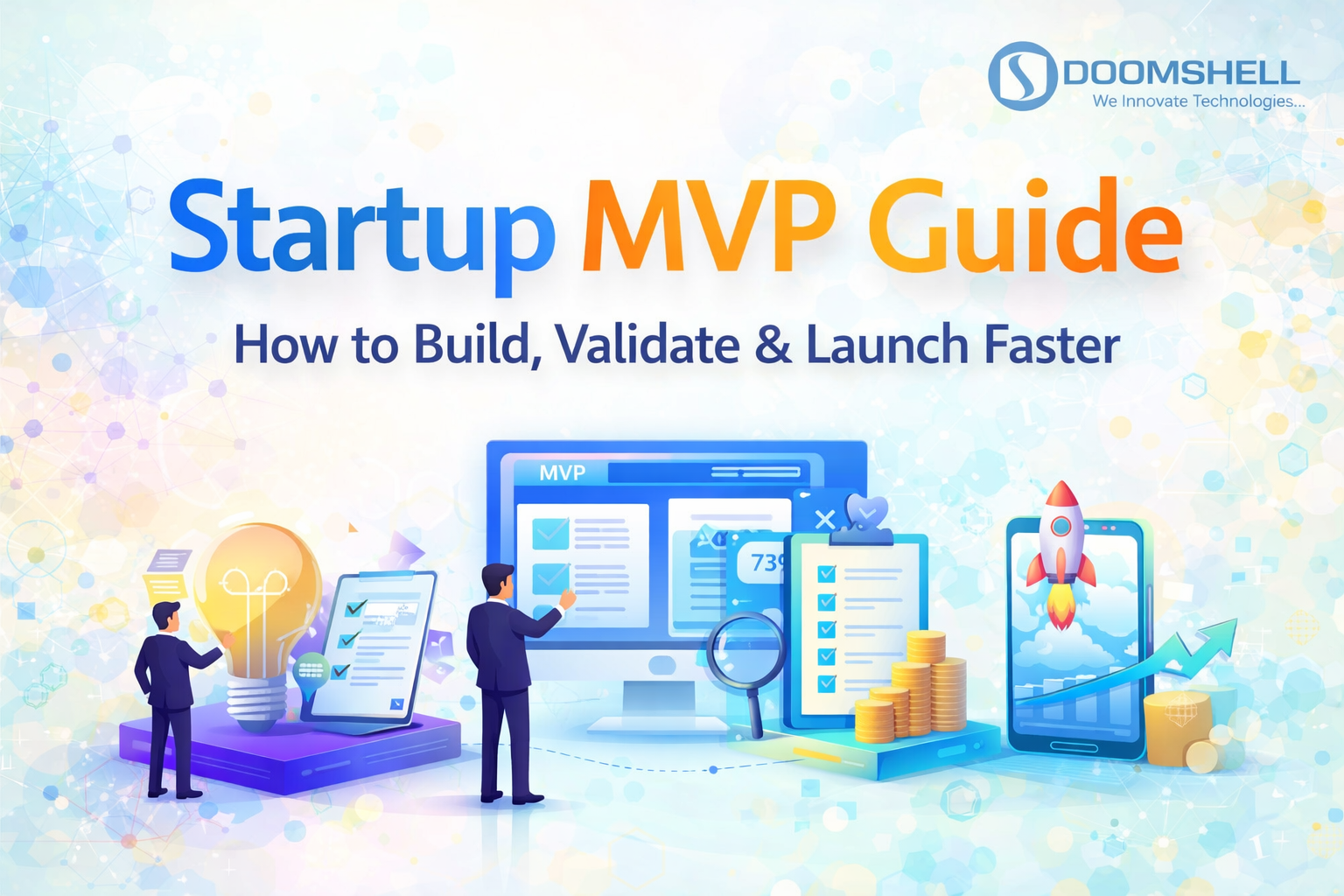
Launching a startup product without validating market demand is one of the biggest reasons new businesses fail. Many founders spend months building complex products only to discover that customers do not need all the features they developed.
This is where an MVP for Startups becomes essential. A Minimum Viable Product helps founders test their ideas with real users before making significant investments in development. Instead of building a complete product, startups focus on creating a basic version that solves a specific problem.
A structured MVP development process allows businesses to gather feedback, validate assumptions, and improve the product based on actual user behavior. With the right MVP launch strategy, startups can reduce risk, save development costs, and reach the market faster.
In this startup MVP guide, you will learn how to build, launch, and improve a Minimum Viable Product while achieving long-term product-market fit.
What Is an MVP (Minimum Viable Product)?
A Minimum Viable Product is the first functional version of a product that contains only the essential features required to solve a core customer problem.
The purpose of an MVP is not to create a perfect product. Instead, it helps founders validate ideas, understand customer needs, and collect real-world feedback before investing in full-scale development.
Companies such as Airbnb, Dropbox, and Uber started with simple MVP versions before becoming global brands. Their success demonstrates how early validation can significantly improve long-term business outcomes.
Key Characteristics of an MVP
-
Focuses on solving one primary problem
-
Contains only essential features
-
Enables faster market entry
-
Collects real user feedback
-
Supports future product improvements
-
Reduces development risks
An effective MVP development process ensures startups learn quickly while minimizing unnecessary expenses.
Why MVP Development Matters for Startups
Building a complete product before understanding customer demand can be risky. A startup MVP allows founders to test assumptions and make informed decisions.
Instead of spending large amounts on development, startups can launch a simplified version and evaluate market response.
Benefits of MVP Development
-
Faster product validation
-
Lower development costs
-
Reduced business risk
-
Better customer insights
-
Improved decision-making
-
Quicker time-to-market
Many successful startups achieve product-market fit because they focus on learning before scaling.
Market Trends Driving MVP Adoption
The startup ecosystem has increasingly adopted lean development methodologies over the past decade.
Industry reports show that startups using MVP development often reach validation faster than those building fully featured products from the beginning.
Current MVP Market Insights
-
MVP adoption continues to grow globally
-
Startups achieve faster product validation
-
Development costs can decrease significantly
-
User feedback improves product quality
-
Early launches support rapid iteration
-
Lean development increases success rates
These trends highlight why an MVP for Startups has become a preferred approach for modern product development.
Why Most Startups Fail at MVP Development
Many startups understand the concept of an MVP but struggle during execution.
Several common mistakes prevent founders from achieving meaningful validation.
1. Building Too Many Features
One of the biggest mistakes is ignoring MVP feature prioritization. Founders often add unnecessary features before validating the core idea.
As a result, development takes longer and costs increase significantly.
2. Skipping Market Validation
Without proper research, startups risk solving problems that customers do not actually have.
Early validation helps avoid this issue.
3. Weak MVP Launch Strategy
A great product can fail if it never reaches the right audience.
Launching without a clear marketing plan limits valuable user feedback.
4. Ignoring Customer Feedback
Feedback is one of the most important benefits of launching an MVP.
Ignoring user insights can slow growth and delay product-market fit.
MVP Development Process: Step-by-Step Guide
A successful MVP development process follows a structured approach.
Step 1: Identify the Core Problem
Start by understanding the main challenge your product will solve.
Ask yourself:
-
What problem exists?
-
Who experiences this problem?
-
Why is it important to solve?
Strong problem validation forms the foundation of a successful product.
Step 2: Define Your Target Audience
Understanding your audience helps create a product that addresses real customer needs.
Focus on:
-
Customer demographics
-
Pain points
-
Buying behavior
-
Market demand
Detailed user research improves development decisions.
Step 3: Prioritize Essential Features
Effective MVP feature prioritization ensures the product remains simple and focused.
Include only features that directly solve the primary problem.
Examples of Features to Prioritize
-
User registration
-
Core functionality
-
Basic dashboard
-
Payment processing
-
Customer support
Avoid adding advanced features during the first release.
Step 4: Build the MVP
Once priorities are clear, begin development using agile methodologies.
The goal is to create a working product that delivers value quickly.
Step 5: Launch Early
An effective MVP launch strategy focuses on reaching early adopters.
Collect feedback, track user behavior, and identify improvement opportunities.
Step 6: Analyze Feedback and Improve
Use customer insights to refine the product.
This feedback loop helps startups improve features and move closer to product-market fit.
MVP vs Full Product
| Feature | MVP | Full Product |
|---|---|---|
| Purpose | Validate ideas | Serve broader market |
| Features | Essential only | Comprehensive feature set |
| Development Time | Short | Long |
| Cost | Lower | Higher |
| Risk | Reduced | Higher |
| Feedback | Early-stage | Post-launch |
| Flexibility | High | Lower |
Understanding these differences helps founders make smarter development decisions.
Why MVP Is Critical for Startup Success
An MVP provides a practical way to test business ideas before committing significant resources.
Faster Idea Validation
Founders can determine whether customers truly need the solution.
Lower Development Costs
By focusing on essential functionality, startups avoid unnecessary expenses.
Better Customer Insights
User feedback provides valuable information about product improvements.
Quicker Market Entry
Startups can launch faster and establish market presence early.
Improved Return on Investment
Early validation reduces waste and increases development efficiency.
Pro Tips for Successful MVP Development
Building an MVP requires discipline and focus.
Focus on the Core Problem
Avoid adding features that do not contribute directly to solving the main issue.
Prioritize User Feedback
Listen carefully to early adopters and use their suggestions to improve the product.
Use Agile Development
Agile methods support faster updates and continuous improvement.
Launch Quickly
Perfection should not delay market validation.
The sooner users interact with your product, the sooner you can improve it.
Track Key Metrics
Monitor:
-
User retention
-
Customer acquisition
-
Engagement levels
-
Conversion rates
-
Customer feedback
These metrics help guide future development decisions.
How Doomshell Helps Startups Build Successful MVPs
Developing an MVP requires technical expertise, market understanding, and strategic planning.
Doomshell helps startups accelerate development while minimizing risks.
Expert MVP Development Services
Our team builds scalable and efficient MVP solutions tailored to startup goals.
Strategic Feature Prioritization
We identify the most important features to maximize value and reduce development costs.
Agile Product Development
Our agile methodology supports faster releases and continuous improvements.
End-to-End Product Support
From idea validation to launch and optimization, we guide startups through every stage of development.
Conclusion
A Minimum Viable Product is one of the most effective tools for startup success. Instead of investing heavily in a full product from day one, founders can validate ideas, collect customer feedback, and refine their solutions through a structured MVP development process.
By focusing on MVP feature prioritization, following a clear MVP launch strategy, and continuously improving based on user feedback, startups can significantly increase their chances of achieving product-market fit.
Whether you are launching your first startup or developing a new digital product, an MVP provides the fastest path to learning, validation, and sustainable growth.
Frequently Asked Questions
1. What is an MVP in startup development?
A Minimum Viable Product is the first version of a product containing only essential features needed to validate an idea and gather user feedback.
2. Why is MVP development important for startups?
It helps reduce risk, lower development costs, validate demand, and improve product-market fit before large investments are made.
3. How do I prioritize features for my MVP?
Focus only on features that solve the primary customer problem and remove anything that does not provide immediate value.
4. When should I launch my MVP?
Launch as soon as the core functionality is ready and capable of delivering value to early users.
5. How can I improve my MVP after launch?
Collect customer feedback, analyze user behavior, monitor performance metrics, and continuously refine the product based on insights.